
Cabinet Approves First-Ever Deportation Regulation, Tightens Measures to Immediately Repatriate Illegal Foreign Nationals
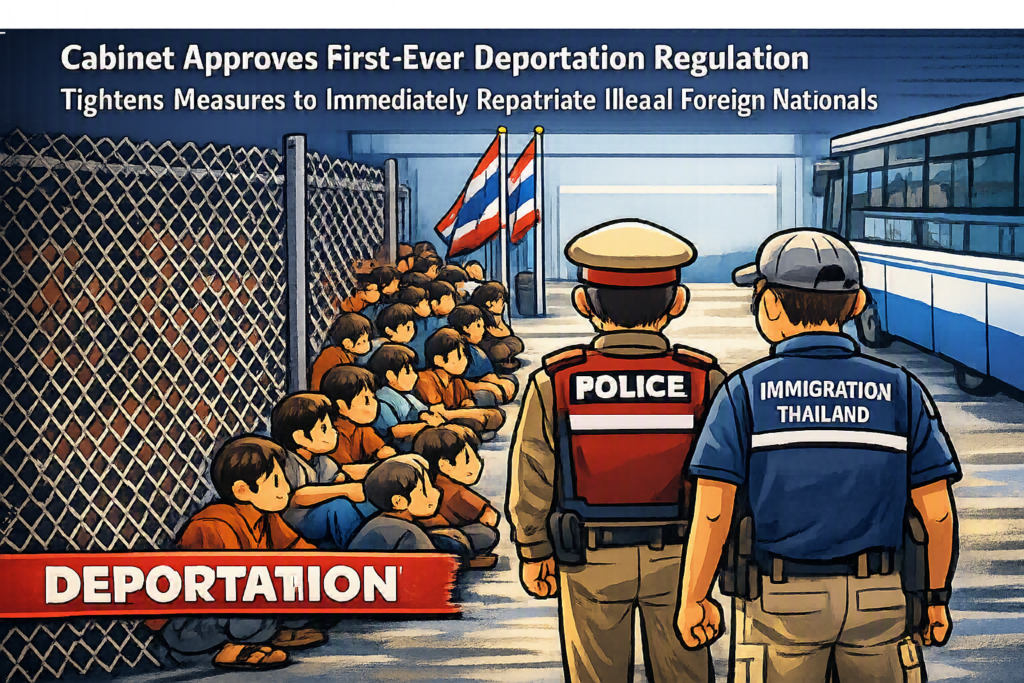
On 14 July, Ms. Ratchada Thanadirek, spokesperson for the Prime Minister’s Office, announced that following the Cabinet meeting on 16 June 2026, Deputy Prime Minister Pakorn Nilprapunt was assigned to coordinate with relevant agencies to review and amend laws, regulations, and rules related to immigration. The goal is to speed up the process of deporting foreign nationals who have committed offenses or entered Thailand illegally.
She explained that Thailand currently has no formal government regulation specifically governing deportation procedures, despite the need for close coordination among various state agencies. Therefore, it is necessary to establish a deportation regulation to ensure that deportation-related administration is carried out quickly and efficiently in the national interest.
Today, the Cabinet approved a draft Prime Minister’s Office Regulation on Deportation (B.E. ….), as proposed by Deputy Prime Minister Pakorn Nilprapunt.
The regulation identifies six categories of offenses for which foreign nationals may be deported when necessary to maintain public order and public morality:
- Entering or staying in Thailand illegally.
- Working in Thailand in violation of laws governing foreign workers.
- Conducting business in Thailand in violation of laws governing foreign business operations.
- Forging official documents or using forged government documents.
- Committing criminal offenses punishable by imprisonment of three years or more.
- Acting as a principal offender, instigator, or supporter of any of the offenses listed in items 1–5.
The spokesperson further stated that the draft regulation requires relevant government agencies to take the following actions:
1. Notification Before Release from Prison
The Director-General of the Department of Corrections must provide the foreign national’s name, nationality, case file, evidence, and other relevant information to the Permanent Secretary of the Ministry of Interior, or a designated representative, before the individual is released from prison within the prescribed timeframe.
The Permanent Secretary or designated representative must then report the matter to the Minister of Interior for consideration and issuance of a deportation order without delay.
The Ministry of Interior will be responsible for returning the deportee to their country of nationality. If the person’s nationality cannot be clearly established, they will be deported to the country where they stated they last resided before entering Thailand.
2. Requests from Other Countries or International Organizations
In cases where another country of which the deportee is not a national, or an international organization, wishes to receive the deportee, a formal request must be submitted through diplomatic channels.
The requesting country or organization must declare its willingness to bear all costs associated with the deportee’s care prior to transfer, as well as the transportation expenses for the deportation. The deportee must also provide written consent.
This regulation is intended to create a clear legal framework and streamline coordination among government agencies to enable faster and more effective deportation of foreign nationals who violate Thai law or immigration regulations.